
How to Use a HELOC Payment Calculator
Follow a HELOC calculator guide covering line details, home equity, draw-period principal, results, a worked example, and borrowing comparisons.
How does this guide help you use the HELOC Calculator?
This guide explains which values to enter, how the HELOC Calculator processes them, and how to read the resulting estimate. Follow the sections below to check assumptions, compare realistic scenarios, avoid common input mistakes, and understand when an official source or qualified professional should take priority over a planning result.
A HELOC estimate should compare the interest-only draw period with later principal-and-interest repayment. This guide explains how to enter the line, balance, rate, timing, fees and equity assumptions, then interpret payment shock and variable-rate exposure.
Use the HELOC Payment Calculator for planning. The signed agreement and current statement control the actual rate, balance, payment and account rules.
Before You Start
Gather current account or offer information before calculating. HELOC structures differ, so the calculator should be configured from the agreement rather than a generic advertisement.
- Approved or proposed line limit and current outstanding balance.
- Any new advance being considered.
- Current annual rate and whether it is introductory or fully indexed.
- Years remaining in draw and the repayment-period term.
- Required or planned principal during draw and the annual account fee.
- Estimated property value, first-mortgage balance and a CLTV assumption for context.
Loan Details
- Credit limit: enter the approved or proposed maximum line.
- Current balance: use the outstanding principal, not the original line amount or available credit.
- Additional draw: enter only the new advance being tested. Current balance plus the draw cannot exceed the limit.
- Annual rate: enter the current or scenario rate, such as 8.5 for 8.50%. The base schedule holds it constant.
- Draw years remaining: enter time until advances stop, not the original draw term if years have already passed.
- Repayment years: enter the term used to amortize the remaining balance after draw.
- Schedule start: choose the month and year for the annual schedule labels.
Ownership Costs
Enter the annual HELOC account fee so it appears as a monthly equivalent and in total modeled fees. Application, appraisal, title, closing, transaction, inactivity, early closure and conversion fees are not automatically included.
The home-value, first-mortgage and maximum-CLTV fields estimate how much combined lien capacity the selected assumption might imply. They do not estimate property tax, homeowners insurance, HOA dues, maintenance or the first-mortgage payment.
Keep the complete housing budget in view. A HELOC payment sits beside the first mortgage and ownership expenses, and the home secures the line.
Extra Payments
The monthly principal during draw field models a recurring principal amount in addition to interest and the monthly-equivalent annual fee. Each posting is capped at the remaining balance.
Principal paid during draw reduces the end-of-draw balance, later repayment payment and modeled interest. It also means the first displayed draw payment is higher because it includes that planned principal.
The model does not add future repeated advances after the first month. Use separate scenarios when comparing a single draw with a pattern of future borrowing, and confirm whether the creditor can reduce, freeze or terminate access under the agreement and applicable rules.
Read the Results
- Draw-period payment: first modeled interest, optional principal and monthly-equivalent annual fee.
- Repayment-period payment: amortizing principal and interest on the end-of-draw balance, plus the fee equivalent.
- Payment change: repayment payment minus the first modeled draw payment.
- End-of-draw balance: balance after applying planned monthly draw-period principal.
- Available credit and utilization: unused line and percentage of the entered limit in use.
- Total interest and fees: modeled schedule totals at the constant base rate.
- CLTV capacity: illustrative line amount and remaining equity capacity under the entered assumption.
- Sensitivity and schedule: nearby-rate payments and annual interest, principal, fees and ending balance.
Worked Example
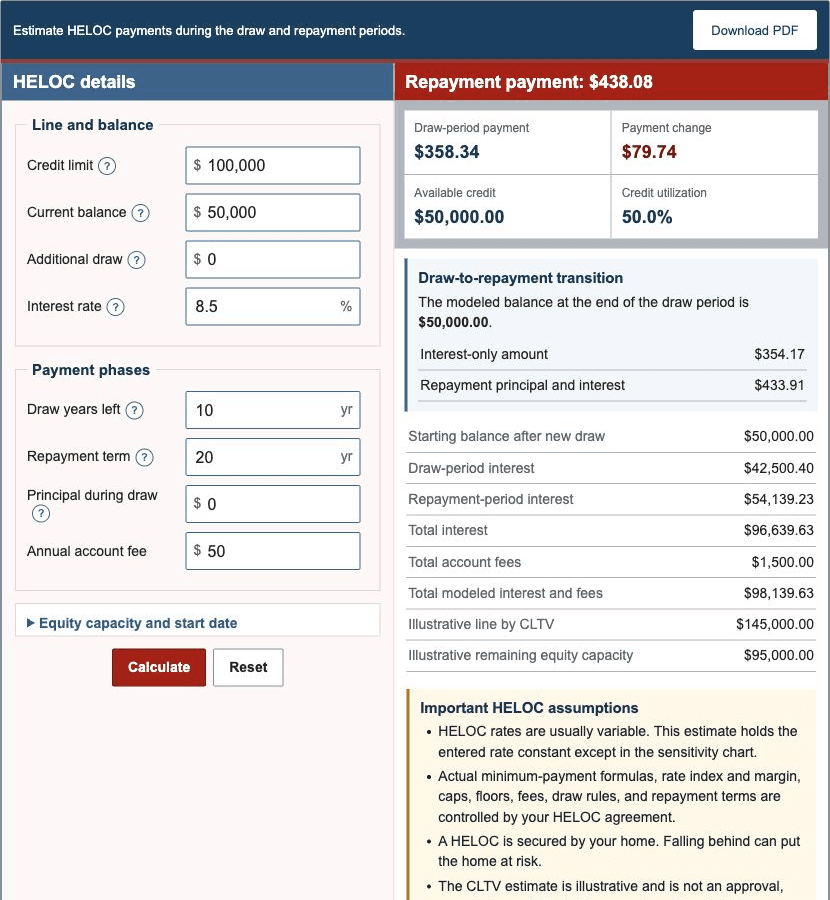
Assume a $100,000 line, $50,000 balance, no new draw, 8.50% annual rate, 10 draw years remaining, 20 repayment years, no draw-period principal and a $50 annual fee.
- Available credit: $100,000 - $50,000 = $50,000.00.
- Utilization: $50,000 / $100,000 = 50.00%.
- Monthly interest: $50,000 x 8.50% / 12 = $354.17.
- Monthly-equivalent annual fee: $50 / 12 = $4.17.
- First draw payment: $358.34.
- With no draw-period principal, end-of-draw balance: $50,000.00.
- Twenty-year amortizing principal and interest: $433.91.
- Repayment payment with fee: $438.08.
- Modeled payment increase: $79.74.
Open Example 1 to compare this baseline with a new advance and recurring draw-period principal.
Compare Loans
Compare a HELOC with closed-end alternatives using the same amount, realistic rates, fees and payoff horizon.
| Option | Structure | Important comparison |
|---|---|---|
| HELOC | Revolving line, often variable rate | Draw flexibility, future rate, payment transition and line-access risk |
| Home equity loan | Closed-end lump sum, often fixed payment | Upfront amount, fixed schedule and closing costs |
| Cash-out refinance | Replaces the first mortgage | New rate on the entire mortgage, term reset and closing costs |
| Personal loan | Usually unsecured installment debt | Rate, term, fees and no home collateral |
Use the Refinance Calculator, Mortgage Payment Calculator and Personal Loan Calculator for consistent comparisons.