
How to Use a SIP Calculator
Follow a step-by-step SIP calculator guide for recurring contributions, frequency, return conventions, step-ups, fees, inflation, timing, and goals.
How does this guide help you use the SIP Calculator?
This guide explains which values to enter, how the SIP Calculator processes them, and how to read the resulting estimate. Follow the sections below to check assumptions, compare realistic scenarios, avoid common input mistakes, and understand when an official source or qualified professional should take priority over a planning result.
This guide explains every field in the SIP Calculator, including contribution frequency, rate convention, annual step-up, fees, inflation, timing, scenarios, and goals.
The result is a projection from your assumptions, not a forecast or investment recommendation.
Before You Start
- Any amount already invested at the start.
- The amount and frequency of recurring contributions.
- The number of whole years in the projection.
- An expected annual return and its convention.
- Annual fees, inflation, and a reasonable lower-to-higher return range.
- A future target expressed in the same currency.
Step 1: Enter Contribution Details
Select a currency, enter any initial investment, then enter the recurring contribution. Choose monthly, quarterly, or annual frequency and the number of years.
Beginning timing adds a scheduled contribution before that month's modeled return and fee. End timing adds it afterward. This difference matters when returns or fees are nonzero.
Step 2: Choose the Annual Return Convention
Nominal mode divides the annual percentage by 12. Effective mode finds the monthly rate that compounds to the entered annual percentage over 12 months. The same percentage can therefore produce different projections.
Step 3: Enter Step-Up and Fee Assumptions
Set annual contribution increase to zero for a flat SIP. A positive percentage raises the recurring amount once at the start of each later projection year; a negative value models a planned reduction.
The annual fee is converted to an equivalent monthly deduction. Fee drag compares this projection with an otherwise identical fee-free projection.
Step 4: Enter Inflation, Return Range, and Goal
Inflation discounts the ending balance into estimated present purchasing power. The return-range field creates lower and higher paths around the entered return. These are sensitivity scenarios, not probabilities.
The goal solver finds the starting recurring amount needed while preserving the selected frequency, timing, step-up, return, fee, term, and initial investment.
Step 5: Read the Results
- Maturity value: projected ending balance after deposits, return, and fees.
- Total invested: initial investment plus every scheduled contribution.
- Estimated returns: maturity value minus total invested.
- Fee drag: difference between fee-free and fee-adjusted ending values.
- Step-up benefit: difference from an otherwise identical flat contribution plan.
- Inflation-adjusted value: ending value discounted by the entered inflation rate.
- Goal result: surplus or shortfall and solved starting contribution.
- Annual schedule: a reconciliation of deposits, returns, fees, and balances.
Worked Example: $10,000 Monthly for 10 Years
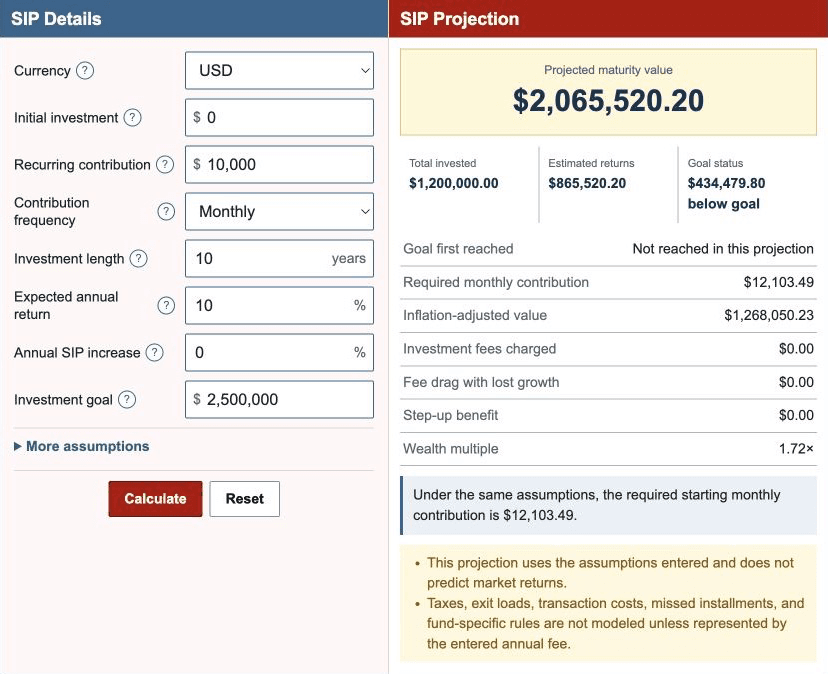
The default contributes $10,000 at each month's beginning for 10 years, assumes a 10% nominal annual return, no fee or step-up, 5% inflation, and a $2,500,000 goal.
| Total invested | $1,200,000.00 |
|---|---|
| Estimated returns | $865,520.20 |
| Projected maturity value | $2,065,520.20 |
| Inflation-adjusted value | $1,268,050.23 |
| Goal gap | $434,479.80 |
| Required starting contribution | $12,103.49 |
These figures are generated by the same production engine as the calculator.
Step 6: Compare Scenarios Carefully
- Reduce the expected return and increase the fee.
- Compare beginning and end contribution timing.
- Test a flat plan and an affordable annual step-up.
- Compare nominal value with inflation-adjusted value.
- Change one assumption at a time.
References
- National Institute of Securities Markets - SIP Calculator
- Investor.gov - Compound Interest Calculator
- SEBI Investor - Financial Education Booklet
Review the SIP formulas and worked SIP examples for the exact model.