
How to Use a Retirement Calculator
Follow a step-by-step retirement calculator guide for savings, income, Social Security, pension, returns, fees, inflation, and longevity.
How does this guide help you use the Retirement Calculator?
This guide explains which values to enter, how the Retirement Calculator processes them, and how to read the resulting estimate. Follow the sections below to check assumptions, compare realistic scenarios, avoid common input mistakes, and understand when an official source or qualified professional should take priority over a planning result.
This guide explains every field in the Retirement Calculator and shows how savings, retirement income, inflation, fees, returns, and longevity interact.
The result is a planning scenario, not a forecast. Use personal records where possible and test more than one set of assumptions.
Before You Start
- Your current retirement-account balances.
- A monthly contribution you can sustain.
- Current age, intended retirement age, and a conservative planning age.
- Desired retirement spending in today's dollars.
- Personal Social Security and pension estimates in today's dollars.
- Reasonable return, fee, inflation, and contribution-growth assumptions.
Step 1: Enter Ages and Savings
Enter your current age
Use your age at the beginning of the scenario.
Choose a retirement age
Contributions stop and retirement withdrawals begin at this age.
Choose a planning age
This is the age through which the calculator tests withdrawals. It must be later than retirement age.
Enter savings and contributions
Use the combined current balance you want modeled and a starting monthly deposit. You can also choose beginning- or end-of-month timing and an annual contribution increase.
Step 2: Enter Retirement Income
Enter the monthly income you want in retirement, then enter your own Social Security and pension estimates. The calculator subtracts those sources from desired income and asks savings to fund only the remaining gap.
If benefits exceed desired income, the portfolio gap is zero. The calculator does not estimate Social Security, taxes, claiming adjustments, or pension survivorship options.
Step 3: Enter Returns, Fees, and Inflation
Use separate effective annual return assumptions before and after retirement. Enter ongoing investment fees as an annual percentage and inflation as an annual rate.
The return range creates lower and higher comparison paths by subtracting and adding percentage points to the base returns. These smooth paths are sensitivity tests, not probabilities.
Step 4: Read the Results Together
- Savings at retirement: projected nominal balance when contributions stop.
- Retirement savings goal: smallest modeled starting balance that funds the income gap through the planning age.
- Surplus or shortfall: difference between projected savings and the goal.
- Required monthly contribution: solved starting deposit needed to reach the goal.
- Sustainable portfolio income: today's-dollar monthly amount the projected balance can support.
- Estimated total income: sustainable portfolio income plus entered Social Security and pension.
- Depletion age: age when the requested portfolio withdrawal can no longer be fully funded, if applicable.
Worked Example: Start at Age 35
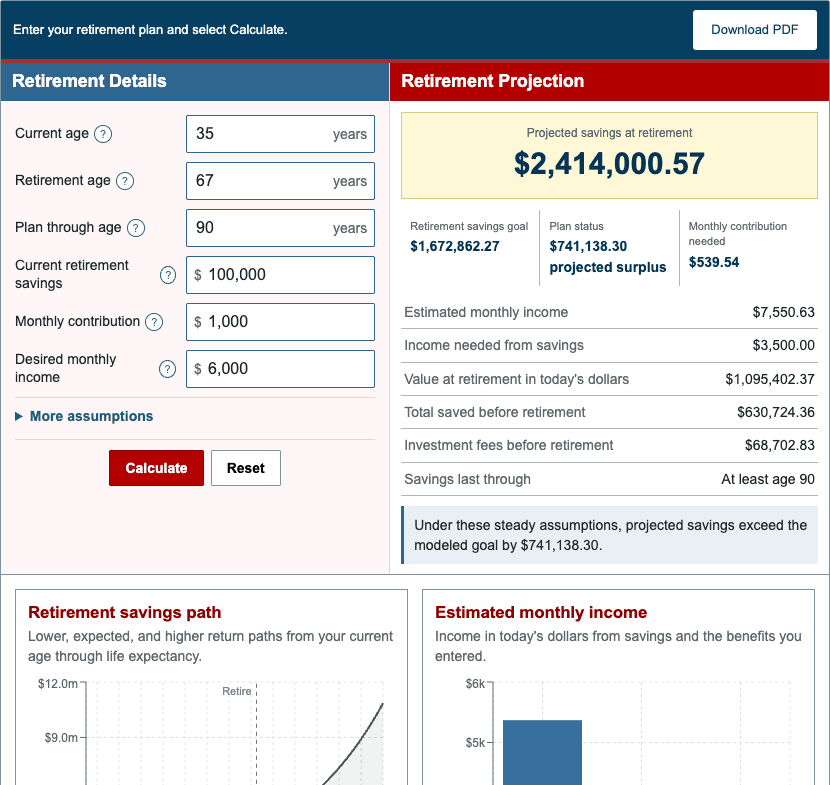
The default scenario begins at age 35 with $100,000.00, adds $1,000.00 monthly through age 67, and plans through age 90. Desired income is $6,000.00 monthly, with $2,500.00 from Social Security.
| Projected savings at retirement | $2,414,000.57 |
|---|---|
| Retirement savings goal | $1,672,862.27 |
| Projected surplus | $741,138.30 |
| Required starting monthly contribution | $539.54 |
| Estimated monthly retirement income | $7,550.63 |
These values use the complete production engine and update automatically if the shared defaults change.
Step 5: Stress-Test the Plan
- Increase planning age to test a longer retirement.
- Reduce expected returns or increase investment fees.
- Increase inflation or desired monthly income.
- Compare an earlier or later retirement age.
- Reduce Social Security or pension estimates.
- Change only one assumption at a time so the cause of the difference remains clear.
References
- U.S. Department of Labor - Taking the Mystery Out of Retirement Planning
- Social Security Administration - Get a benefits estimate
- U.S. SEC Investor.gov - How fees and expenses affect investments
- U.S. Bureau of Labor Statistics - Purchasing power and constant dollars
Review the retirement formulas and worked examples for the exact model.