
How to Use the Due Date Calculator
Learn how to estimate pregnancy due date, week, gestational age, trimester, and milestones from LMP, conception, ultrasound, IVF, or a confirmed due date.
How does this guide help you use the Due Date Calculator?
This guide explains which values to enter, how the Due Date Calculator processes them, and how to read the resulting estimate. Follow the sections below to check assumptions, compare realistic scenarios, avoid common input mistakes, and understand when an official source or qualified professional should take priority over a planning result.
This guide explains how to use the Due Date Calculator with the dating information actually available. The calculator estimates a calendar; it does not decide which source date is clinically correct.
Before You Start
- Use a documented due date when a prenatal professional has already established one.
- For LMP dating, identify the first day of the last menstrual period and average cycle length.
- For ultrasound dating, copy the scan date and exact recorded weeks plus days.
- For IVF, use the actual transfer date and embryo age from the treatment record.
- Choose the calendar date on which you want to know pregnancy progress.
Step 1: Choose the Dating Method
| Method | Use when you know | Important caution |
|---|---|---|
| Due date | A documented EDD | Do not replace it with a reconstructed date without clinical guidance |
| Last menstrual period | First day of LMP and average cycle length | Uncertain dates or irregular cycles can reduce usefulness |
| Conception | Estimated conception or ovulation date | Calendar estimates are not direct confirmation |
| Ultrasound | Scan date and recorded gestational age | Enter values from the same scan |
| IVF | Transfer date and embryo age | Use fertility-clinic records |
Step 2: Enter the As-Of Date
The as-of date controls gestational age, pregnancy week, trimester, percentage progress, elapsed days, remaining days, and the current marker in the charts. It does not change the estimated due date.
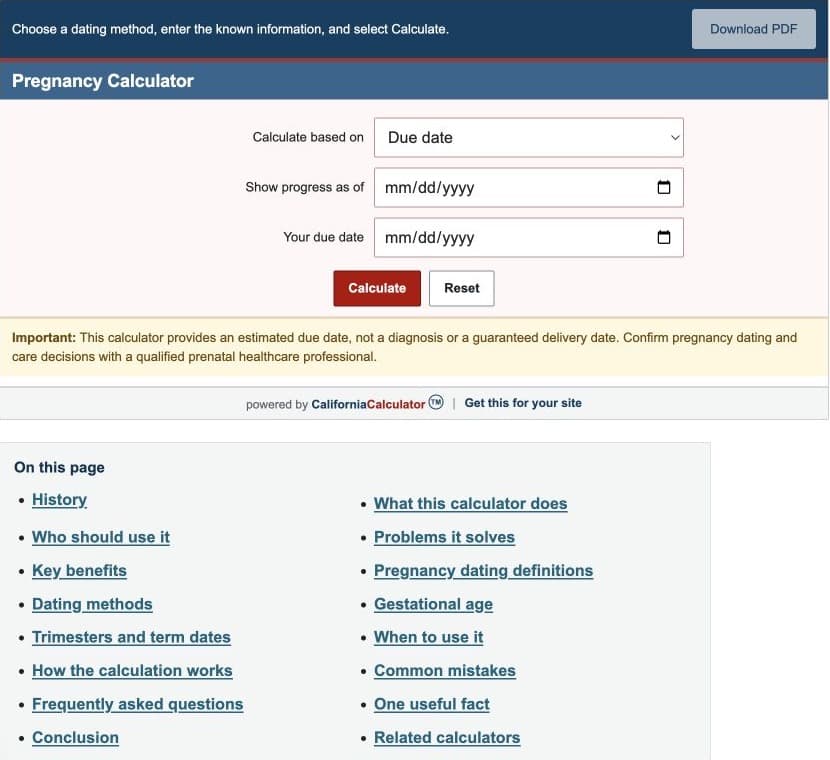
Step 3A: Last Period and Cycle Length
Enter the first day of the last menstrual period. The calculator adds 280 days, then adjusts by the number of days the entered cycle differs from 28. A 32-day cycle adds four days; a 25-day cycle subtracts three.
Step 3B: Known Conception Date
Enter the estimated conception or ovulation date. The calculator adds 266 days. Because ovulation and conception may not be known precisely without assisted-reproduction records, treat this as a calendar estimate.
Step 3C: Ultrasound Dating
Enter the scan date and the completed gestational weeks plus additional days recorded on that date. The calculator subtracts the recorded gestational age from 280 days and adds the remainder to the scan date.
Step 3D: IVF Transfer Dating
Enter the transfer date and the embryo age in completed days. The formula adds 266 days and subtracts embryo age because development began before the transfer date.
Step 4: Read the Results
- Estimated due date: the 40-week calendar estimate.
- Pregnancy week: the numbered week in progress on the as-of date.
- Gestational age: complete weeks and additional days.
- Trimester: based on completed gestational weeks.
- Estimated conception and LMP: dates reconstructed from the EDD.
- Days until or past EDD: difference between as-of date and estimated due date.
- Term dates: calendar dates for early, full, late, and postterm boundaries.
Step 5: Use the Charts and Week Schedule
The progress chart divides the 280-day model into elapsed and remaining days. The trimester chart uses a 42-week display and marks the current gestational position plus the 40-week EDD. The schedule lists 42 consecutive date ranges and milestones. Text and tables provide the same information without relying on the chart.
Worked Example: 28-Day LMP Dating
Enter LMP February 22, 2026, cycle length 28, and as-of date July 31, 2026.
| Estimated due date | November 29, 2026 |
|---|---|
| Estimated conception | March 8, 2026 |
| Gestational age | 22 weeks, 5 days |
| Pregnancy week | Week 23 |
| Trimester | Second trimester |
| Estimated progress | 57% |
| Full term begins | November 22, 2026 |
This example demonstrates calendar arithmetic. It does not establish the clinically correct date for an individual pregnancy.
Limitations and Clinical Context
- The EDD is an estimate, not a guaranteed delivery date.
- The engine cannot assess certainty of the entered LMP or conception date.
- Cycle adjustment is a simple calendar assumption.
- The tool cannot evaluate ultrasound quality, fetal growth, or redating criteria.
- Charts show estimated calendar progress, not pregnancy health.
- Clinical and treatment records should take priority over reconstructed dates.
References
- ACOG - Methods for Estimating the Due Date
- National Library of Medicine - Pregnancy Dating
- NICHD - About Pregnancy
- CDC National Center for Health Statistics - Gestation
Return to the Due Date Calculator or compare the three worked dating examples.