
How to Use a Home Affordability Calculator
Follow a home affordability guide covering loan details, ownership costs, extra payments, results, a worked example, and mortgage offer comparisons.
How does this guide help you use the Home Affordability Calculator?
This guide explains which values to enter, how the Home Affordability Calculator processes them, and how to read the resulting estimate. Follow the sections below to check assumptions, compare realistic scenarios, avoid common input mistakes, and understand when an official source or qualified professional should take priority over a planning result.
Home affordability is a budgeting estimate built from income, debt, purchase cash, mortgage terms and recurring ownership costs. This guide explains how to enter those assumptions, interpret the limiting constraint, and compare loan scenarios without treating the output as an approval amount.
Use the Home Affordability Calculator before shopping and update it when rates, debts, income, property costs or available cash change.
Before You Start
Build a household budget before calculating. The estimated maximum should leave room for income taxes, utilities, maintenance, transportation, food, healthcare, childcare, savings and other priorities.
- Gross annual income expected to be considered for the mortgage.
- Required recurring monthly debt payments.
- Cash available for the down payment without using emergency reserves.
- A realistic fixed mortgage rate and loan term.
- Property-specific or local estimates for taxes, insurance and HOA dues.
- An estimate of closing costs and other cash needed before moving in.
Loan Details
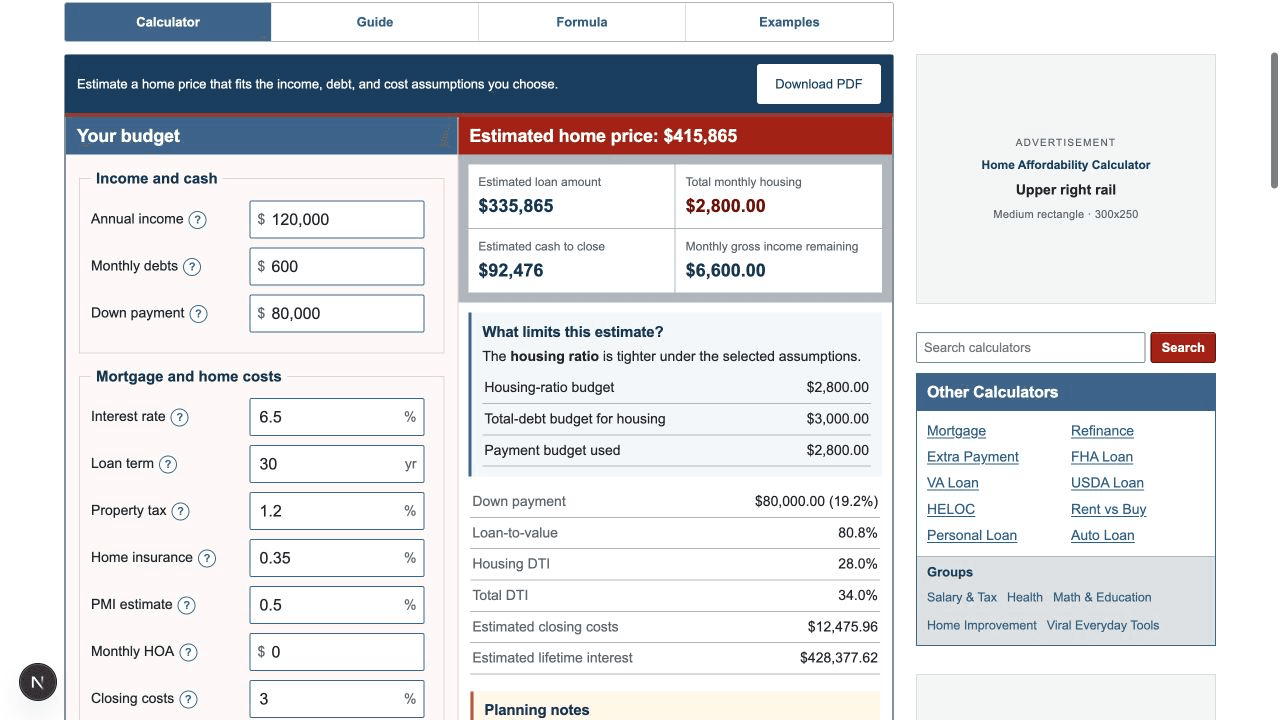
Enter income and debt
- Annual income: use gross income before taxes and payroll deductions.
- Monthly debts: include required auto, student-loan, personal-loan, credit-card, alimony and other recurring payments. Do not enter ordinary living expenses in the DTI field.
Enter cash and mortgage assumptions
- Down payment: enter cash that will be applied directly to the purchase price.
- Interest rate: enter the annual fixed note-rate scenario, such as 6.5 for 6.5%.
- Loan term: choose the repayment term. A shorter term generally supports a lower price at the same payment budget.
- Planning ratios: review the housing and total-debt percentages. They are editable assumptions, not universal lender limits.
Ownership Costs
Principal and interest are only part of a homeowner's monthly cost. Enter realistic values for:
- Property tax: an annual percentage of the estimated home price.
- Homeowners insurance: an annual percentage used to estimate the premium.
- PMI: an annual percentage of the modeled loan, applied when loan-to-value exceeds 80%.
- HOA dues: a recurring monthly amount.
- Closing costs: a percentage of the estimated price added to the down payment for the cash-to-close estimate.
Utilities, maintenance, repairs, inspections, moving expenses, prepaid interest, escrow deposits, reserves, assessments, lender credits and program-specific fees are not automatically included.
Extra Payments
The affordability engine calculates a scheduled monthly payment and does not assume future extra principal. A plan to pay more later does not increase the initial home price that fits the selected monthly housing and total-debt budgets.
If early payoff is an important goal, first use this calculator to estimate a purchase range. Then enter the resulting balance, rate and term in the Extra Payment Calculator to test monthly, annual, lump-sum and target-payoff strategies.
Do not increase the affordable price because you expect a future bonus or uncertain income. Test extra payments only after confirming that the required payment and ownership costs fit the regular budget.
Read the Results
- Estimated home price: highest price found within the selected modeled payment budget.
- Estimated loan: home price minus the entered down payment.
- Maximum housing payment: smaller of the housing-ratio budget and total-debt budget after recurring debts.
- Limiting constraint: identifies which ratio controls the estimate.
- Payment breakdown: principal, interest, property tax, insurance, PMI when modeled and HOA.
- Cash to close: down payment plus estimated closing costs.
- Housing and total DTI: modeled housing or total debt divided by gross monthly income.
- Remaining gross income: income left after modeled housing and entered debt, before taxes and living expenses.
Worked Example
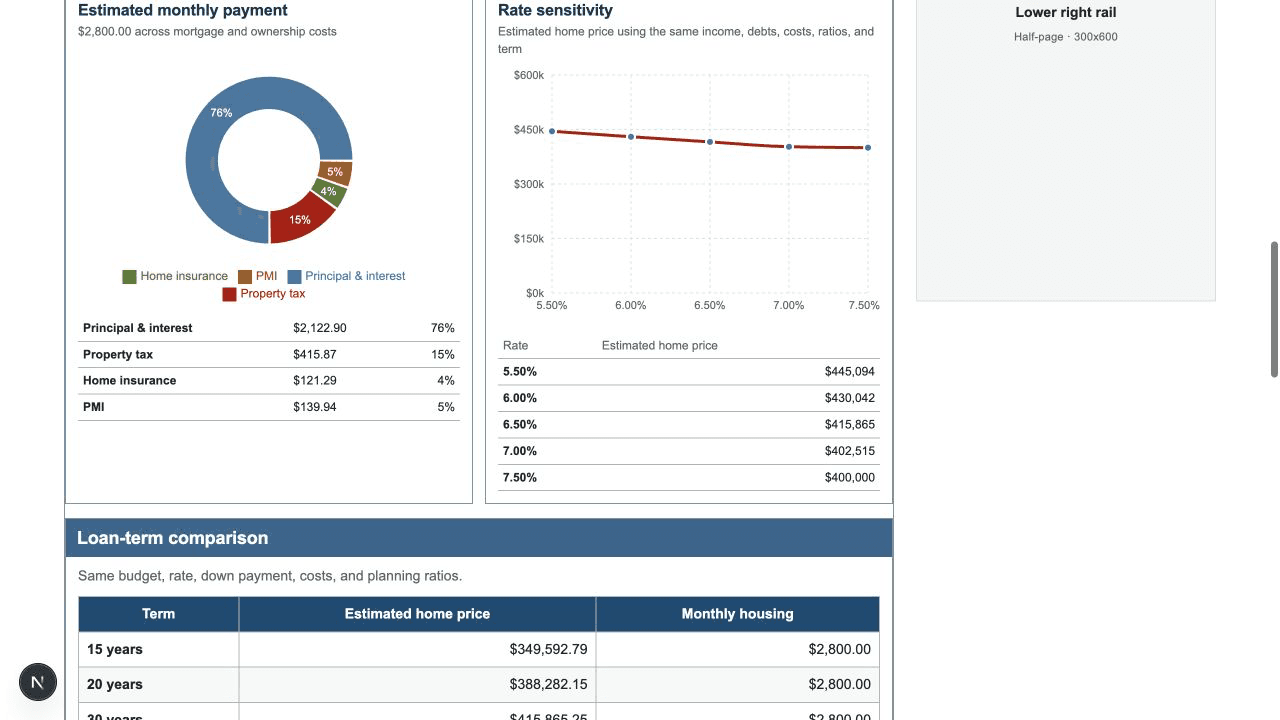
Assume annual gross income of $120,000, monthly debts of $600, and an $80,000 down payment. Use a 30-year fixed loan at 6.5%, 1.2% property tax, 0.35% insurance, 0.5% PMI, no HOA, 3% closing costs, and 28% / 36% planning ratios.
- Gross monthly income is $10,000.
- The housing-ratio budget is $10,000 x 28% = $2,800.
- The total-debt budget available for housing is $10,000 x 36% - $600 = $3,000.
- The smaller $2,800 housing budget controls.
- The solver estimates a home price of $415,865.25 and a loan of $335,865.25.
- Modeled principal and interest are $2,122.90; taxes are $415.87; insurance is $121.29; and PMI is $139.94.
- Total modeled housing cost is $2,800.00.
- Estimated cash to close is $92,475.96.
This is the independently checked regression scenario used by the engine. See the three home affordability examples for debt-limited and higher-rate scenarios.
Compare Loans
Run a separate affordability scenario for each mortgage offer while keeping income, debts, down payment and ownership costs unchanged. Then compare the complete estimated payment, cash requirement and long-term interest.
| Comparison item | Why it matters |
|---|---|
| Loan amount | Shows how price and down payment translate into borrowed principal. |
| Note rate and term | Determine principal-and-interest cost and rate sensitivity. |
| Mortgage insurance | Can materially change the monthly payment when applicable. |
| Closing costs and credits | Change the cash needed and broader cost of the loan. |
| Property tax and insurance | Can differ by property and are not controlled by the mortgage note rate. |
| Cash reserves | Help absorb repairs, moving expenses and financial disruptions after closing. |
Compare official Loan Estimates with consistent assumptions. A lower interest rate does not automatically produce the lowest overall cost if fees, mortgage insurance or loan terms differ.