
How to Calculate Fractions and Mixed Numbers
Learn how to add, subtract, multiply, divide, simplify, and convert fractions and mixed numbers with clear rules, examples, and input guidance.
How does this guide help you use the Fraction Calculator?
This guide explains which values to enter, how the Fraction Calculator processes them, and how to read the resulting estimate. Follow the sections below to check assumptions, compare realistic scenarios, avoid common input mistakes, and understand when an official source or qualified professional should take priority over a planning result.
Before You Start
A fraction has a numerator above the fraction bar and a nonzero denominator below it. A mixed number combines a whole number with a proper fraction. Keep each denominator greater than zero and use the sign on the whole value when the number is negative.
Step 1: Enter the Fractions or Mixed Numbers
- Leave the whole-number field blank or enter 0 for an ordinary fraction.
- Enter an integer numerator and a denominator greater than zero.
- Repeat the process for the second value when using an arithmetic operation.
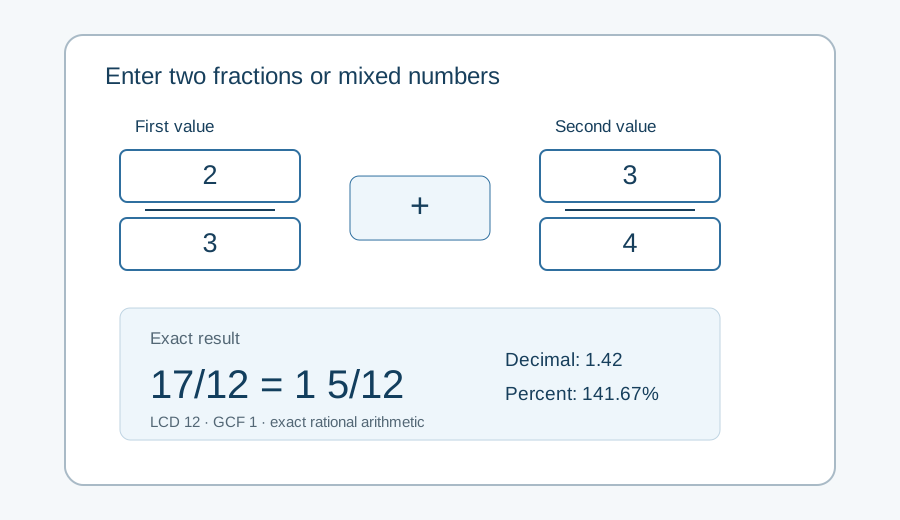
Step 2: Choose an Operation
Select addition, subtraction, multiplication, or division. Addition and subtraction use equivalent fractions with a common denominator. Multiplication works across the numerators and denominators. Division multiplies the first fraction by the reciprocal of the second, which means the second value cannot be zero.
Step 3: Read the Exact and Rounded Results
- Reduced fraction: the exact answer in lowest terms.
- Mixed number: the same exact value split into a whole part and proper fraction when applicable.
- Decimal: a convenient approximation rounded to two decimal places when it repeats.
- Percentage: the decimal value multiplied by 100 and displayed to two decimal places.
- LCD and GCF: the least common denominator used for addition or subtraction and the greatest common factor used to reduce the result.
Common Fraction Mistakes
- Adding denominators instead of creating equivalent fractions.
- Forgetting to invert the second fraction when dividing.
- Entering zero as a denominator or dividing by a zero-valued fraction.
- Treating a rounded decimal as more exact than the reduced fraction.
Use the Fraction Calculator with steps to verify the arithmetic and see each transformation.
References
Report an issue through the Contact Us page.