
How to Use an FHA Loan Calculator
Follow an FHA loan calculator guide covering loan details, ownership costs, extra payments, results, a worked example, and mortgage comparisons.
How does this guide help you use the FHA Loan Calculator?
This guide explains which values to enter, how the FHA Loan Calculator processes them, and how to read the resulting estimate. Follow the sections below to check assumptions, compare realistic scenarios, avoid common input mistakes, and understand when an official source or qualified professional should take priority over a planning result.
An FHA mortgage estimate combines a fixed principal-and-interest payment with upfront and annual mortgage insurance, property costs and cash needed at closing. This guide explains what to enter, how to read the output and which details require confirmation.
Use the FHA Loan Calculator to create a planning scenario, then compare the result with official disclosures from an FHA-approved lender.
Before You Start
Collect property-specific information. A national average can produce a misleading estimate when local taxes, insurance, HOA dues, closing costs or FHA loan limits differ.
- Expected purchase price and cash down payment.
- A fixed annual note-rate scenario and loan term.
- The FHA loan limit for the county or metropolitan area, property-unit count and case-number year.
- Annual property tax and homeowners insurance estimates.
- Monthly HOA or condominium dues, if applicable.
- Borrower-paid closing costs and a choice to finance or pay upfront MIP in cash.
Loan Details
- Purchase price: enter the expected price. The engine uses it as a value proxy, while actual FHA maximum-mortgage calculations use the applicable adjusted value under HUD policy.
- Down payment: enter cash applied to the price. The calculator reports the resulting percentage and original LTV.
- Interest rate: enter a fixed annual note rate, such as 6.25 for 6.25%. It is not a live rate quote.
- Loan term: select the amortization term. Annual MIP rates differ for terms above 15 years and terms of 15 years or less.
- Local FHA loan limit: replace the default national floor with the correct county and unit limit when different.
- Upfront MIP choice: financing the premium increases the mortgage balance; paying it in cash increases estimated cash to close.
Ownership Costs
Enter annual property tax, annual homeowners insurance and monthly HOA dues. The calculator divides annual amounts by 12 and adds them to the initial monthly payment.
Enter borrower-paid closing costs as a dollar amount. The cash-to-close estimate combines down payment and closing costs, plus upfront MIP only when the premium is paid in cash.
Prepaid interest, initial escrow deposits, inspections, repairs, moving expenses, reserves, discount points, lender credits, grants and seller contributions are not automatically modeled.
Extra Payments
The FHA calculator models scheduled monthly payments and does not apply voluntary extra principal. Its annual schedule assumes the original payment continues for the selected term.
After calculating the financed loan amount, rate and term, enter those values in the Extra Payment Calculator to test monthly, annual, one-time or target-payoff strategies. Confirm with the servicer how extra payments will be applied.
Extra principal may reduce interest and shorten payoff time, but this calculator does not assume that annual FHA MIP will end earlier than the original duration rule shown for the scenario.
Read the Results
- Initial monthly payment: principal, interest, initial FHA MIP, property tax, homeowners insurance and HOA dues.
- Base FHA loan: purchase price minus down payment and the amount compared with the entered FHA limit.
- Financed loan: base loan plus upfront MIP when financing is selected.
- MIP rate and duration: the annual rate and assessment period selected from the modeled HUD schedule.
- Cash to close: entered down payment and closing costs, plus upfront MIP when paid in cash.
- Limit check: the difference between the base loan and the local limit entered.
- Annual schedule: beginning balance, principal, interest, annual MIP and ending balance by year.
Worked Example
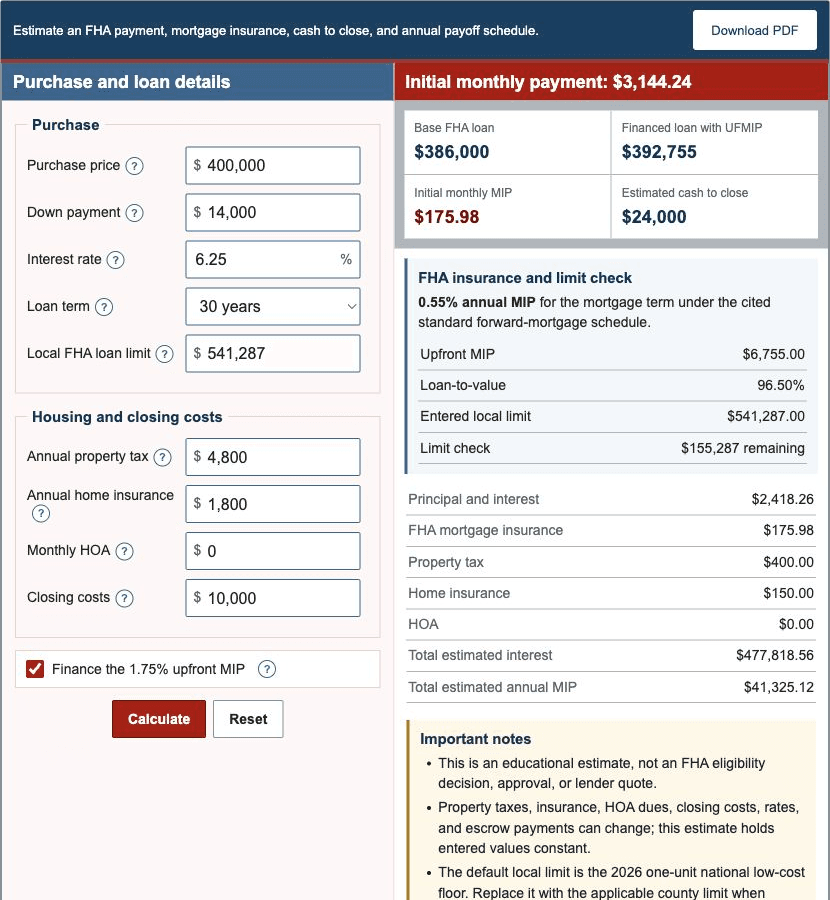
Assume a $400,000 purchase, $14,000 down payment, 6.25% fixed rate, 30-year term, $4,800 annual property tax, $1,800 annual homeowners insurance, no HOA, $10,000 closing costs and financed upfront MIP.
- Base loan: $400,000 - $14,000 = $386,000.00.
- Upfront MIP: $386,000 x 1.75% = $6,755.00.
- Financed balance: $386,000 + $6,755 = $392,755.00.
- Fixed principal and interest: $2,418.26 per month.
- Original LTV is 96.50%, producing a modeled 0.55% annual MIP rate for the term.
- Initial total monthly payment is approximately $3,144.24.
- Estimated cash to close is $24,000.00 because upfront MIP is financed.
See Example 1 for the complete scenario and comparison table.
Compare Loans
Run the same property and cost assumptions with different rates, terms, down payments and upfront-MIP choices. Then compare FHA with other loan programs for which the borrower may be eligible.
- Compare the full monthly payment, not only the note rate.
- Compare cash to close, lender fees, credits, discount points and mortgage insurance.
- Review how long mortgage insurance applies and whether it can end under the program's rules.
- Compare the annual percentage rate, projected payments and five-year cost on official Loan Estimates.
- Consider how long you expect to keep the property and mortgage.
The Mortgage Payment Calculator, VA Loan Calculator and USDA Loan Calculator can help organize alternative planning scenarios, but program eligibility and lender offers must be verified separately.
References
- U.S. Department of Housing and Urban Development - FHA mortgage limits
- HUD Mortgagee Letter 2025-23 - 2026 nationwide forward mortgage loan limits
- HUD Mortgagee Letter 2023-05 - annual mortgage insurance premium schedule
- HUD - Monthly mortgage insurance premium calculation
- Consumer Financial Protection Bureau - Loan Estimate explainer