
How to Use the Body Fat Calculator
Learn how to take repeatable neck, waist, hip, height, and weight measurements, choose a body-fat equation, and interpret estimated results.
How does this guide help you use the Body Fat Calculator?
This guide explains which values to enter, how the Body Fat Calculator processes them, and how to read the resulting estimate. Follow the sections below to check assumptions, compare realistic scenarios, avoid common input mistakes, and understand when an official source or qualified professional should take priority over a planning result.
This guide explains how to use the Body Fat Calculator and take repeatable measurements. Tape technique can affect the estimate more than the final displayed decimal, so consistency matters.
Before You Start
Use a flexible, non-stretch tape and take measurements under similar conditions each time. Stand naturally, keep the tape level, and hold it snug without compressing the skin.
- Use current measurements.
- Measure directly against the body or over minimal clothing.
- Take each circumference at least twice.
- If repeated values differ, recheck the tape position and tension.
- Record the landmark and time of day when tracking a trend.
Step 1: Choose an Estimation Method
| Method | Required predictors | Best use in this calculator |
|---|---|---|
| Circumference | Height, neck, waist, and female hip measurement | When repeatable tape measurements are available |
| Relative Fat Mass | Height, waist, and published sex term | A simple waist-to-height estimate |
| BMI-based | Height, weight, age, and published sex term | When circumference measurements are unavailable |
All three estimates are still shown for comparison, regardless of the selected headline method.
Step 2: Choose U.S. or Metric Units
Select U.S. units for feet, inches, and pounds or metric units for centimeters and kilograms. The calculator converts all entries before applying the equations. Never mix values from different unit systems in one measurement set.
Step 3: Measure Height and Weight
Measure height without shoes on a level floor and against a vertical surface. Use a scale on a firm floor for weight. Height and weight feed the BMI-based equation; height also feeds the circumference and RFM equations.
Step 4: Measure Neck Circumference
Place the tape just below the larynx and keep the measurement consistent from session to session. Keep your head in a natural position and avoid tightening the tape into the skin.
The neck measurement affects the circumference equation only. It does not affect RFM or the BMI-based estimate.
Step 5: Measure Waist Circumference
For the male legacy circumference equation, measure the abdomen horizontally at the navel after a normal exhale. For the female equation, use the consistent waist landmark described by the method, commonly the narrowest natural waist. Keep the abdomen relaxed.
Waist circumference affects both the circumference and RFM estimates. A small difference in tape placement can change two of the three comparison results.
Step 6: Measure Hip Circumference When Required
For the female circumference equation, place the tape around the widest point of the hips and buttocks while keeping it horizontal. The hip input is not used in the male circumference equation, RFM, or BMI-based estimate.
Step 7: Read the Results
- Estimated body fat: the selected equation's output.
- Estimated fat mass: weight multiplied by the selected percentage.
- Estimated lean mass: weight minus estimated fat mass.
- Waist-to-height ratio: waist divided by height.
- Method spread: the difference between the highest and lowest equation estimates.
- Charts and table: visual and text alternatives for composition and method comparison.
Step 8: Compare the Methods
Do not average the three estimates automatically. Each formula was derived from different predictors and research populations. Instead, use the comparison to understand model variation and choose one method for consistent trend tracking.
Worked Example: Male Circumference Estimate
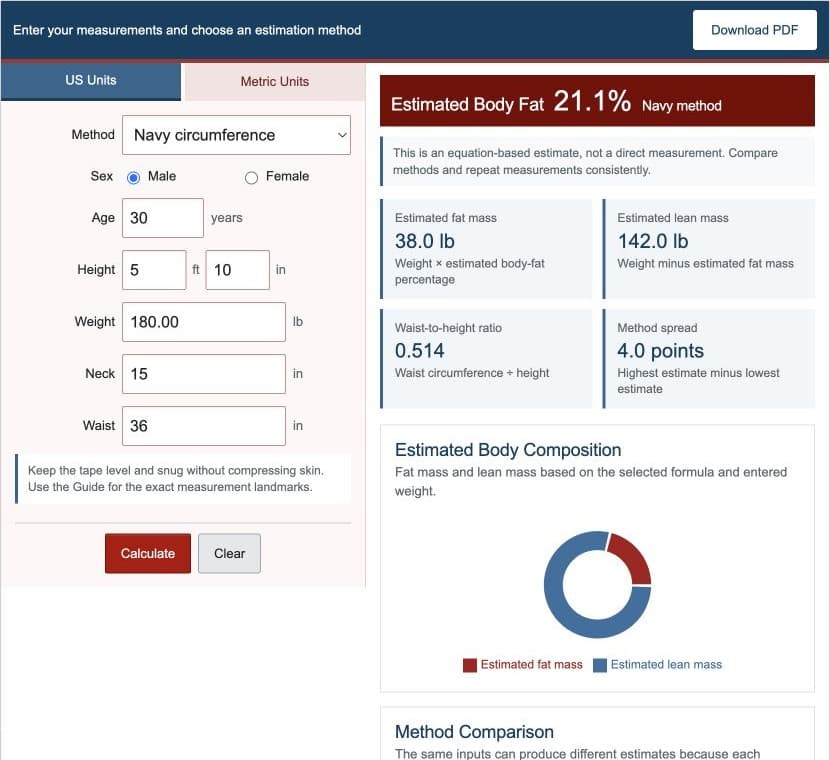
The default example uses age 30, height 5 feet 10 inches, weight 180 pounds, neck 15 inches, and waist 36 inches.
| Selected estimate | 21.1% |
|---|---|
| Estimated fat mass | 38.0 lb |
| Estimated lean mass | 142.0 lb |
| RFM comparison | 25.1% |
| BMI-based comparison | 21.7% |
| Method spread | 4.0 percentage points |
These numbers are generated by the same tested engine as the live calculator.
Step 9: Understand the Limitations
- The equations predict population relationships and do not directly measure tissue.
- Estimated lean mass includes more than muscle.
- The calculator is restricted to adults and is not designed for pregnancy.
- Hydration, tape technique, body shape, age, and the population used to derive an equation can affect agreement with an instrument-based assessment.
- The legacy circumference equation is not the current official Navy eligibility procedure.
If precision matters, ask a qualified professional about a validated assessment such as air-displacement plethysmography or DXA and its limitations.
References
- Woolcott and Bergman - Relative Fat Mass
- Deurenberg, Weststrate, and Seidell - BMI-Based Body-Fat Prediction
- U.S. Navy - Current Body Composition Assessment Guide
- Military Health System - Bod Pod Body Composition Assessment
Review the body-fat formulas and worked examples for the exact calculations.