
How to Use the BMR Calculator
Learn how to enter BMR measurements, compare Mifflin-St Jeor, Harris-Benedict, and Katch-McArdle, and interpret resting energy correctly.
How does this guide help you use the BMR Calculator?
This guide explains which values to enter, how the BMR Calculator processes them, and how to read the resulting estimate. Follow the sections below to check assumptions, compare realistic scenarios, avoid common input mistakes, and understand when an official source or qualified professional should take priority over a planning result.
This guide explains how to use the BMR Calculator, why the equations can disagree, and why a basal metabolic rate estimate is not the same as maintenance calories.
Before You Start
- Use current measurements rather than a goal weight.
- Confirm whether the form is using U.S. or metric units.
- Use body-fat percentage only when it comes from a reasonably credible estimate.
- Remember that every result is a prediction from population data.
- Do not use this adult calculator for children, pregnancy, breastfeeding, illness, or medical nutrition therapy.
Step 1: Enter Current Measurements
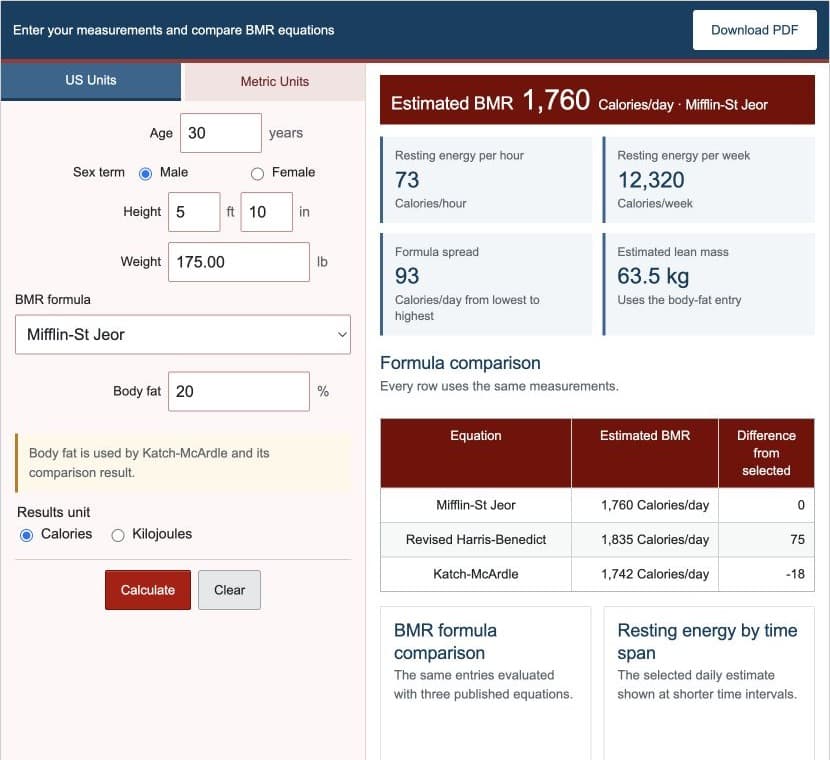
Enter age in completed years, current height, and current body weight. Select U.S. units for feet, inches, and pounds or metric units for centimeters and kilograms. The engine normalizes every measurement before applying an equation.
Step 2: Choose the Published Sex Term
Mifflin-St Jeor and revised Harris-Benedict contain separate constants and coefficients for male and female equations. Choose the term that applies to the published model you intend to use. Katch-McArdle does not use this field because it calculates from estimated lean body mass.
Step 3: Choose a BMR Formula
| Formula | Inputs used | Main caution |
|---|---|---|
| Mifflin-St Jeor | Weight, height, age, sex term | General adult prediction equation, not a measurement |
| Revised Harris-Benedict | Weight, height, age, sex term | Different coefficients can produce a different result |
| Katch-McArdle | Weight and body-fat percentage | Result depends directly on body-fat accuracy |
Mifflin-St Jeor is the default general-adult estimate. The calculator still runs every supported formula so that you can inspect the spread.
Step 4: Enter Body Fat for Katch-McArdle
Katch-McArdle first estimates lean body mass. An overestimated body-fat percentage produces a lower lean-mass estimate, while an underestimated percentage produces a higher one. Use the Body Fat Calculator as a screening estimate or enter a professionally measured value when available.
Step 5: Choose the Result Unit
Calories and kilojoules express the same energy in different units. Changing the display unit does not rerun the metabolic equation or alter the underlying estimate. One dietary Calorie equals 4.184 kilojoules.
Step 6: Read the BMR Results
- Estimated BMR: the selected formula in energy per day.
- Hourly resting energy: daily BMR divided by 24.
- Weekly resting energy: daily BMR multiplied by seven.
- Estimated lean mass: weight after subtracting estimated fat mass.
- Formula spread: the highest equation result minus the lowest.
- Comparison table: all equation outputs for the same inputs.
The hourly and weekly values are time conversions, not separate physiological measurements.
Step 7: Compare the Equations and Charts
The formula chart shows how the three prediction equations differ. The comparison table provides the same information without relying on color or pointer interaction. A larger spread indicates model disagreement for the entered profile; it is not a confidence interval.
Do not select an equation only because it produces a preferred number. Use one method consistently, understand its inputs, and move to the TDEE Calculator when the question is total daily energy.
Worked Example: Adult BMR Estimate
A 30-year-old man is 5 feet 10 inches tall, weighs 175 pounds, enters 20% body fat, and selects Mifflin-St Jeor.
| Metric height | 177.80 cm |
|---|---|
| Metric weight | 79.38 kg |
| Selected BMR | 1760 Calories/day |
| Energy in kilojoules | 7364 kJ/day |
| Estimated lean mass | 63.50 kg |
| Formula spread | 93 Calories/day |
These values are generated by the same tested engine as the live calculator.
Step 8: Understand the Limitations
- Prediction equations can differ from indirect calorimetry.
- The sex-specific terms do not capture every source of metabolic variation.
- Katch-McArdle inherits body-fat measurement error.
- BMR does not include ordinary activity, exercise, or the thermic effect of food.
- The formula spread measures disagreement only; it does not identify the true value.
- The configured input ranges are intended for general adult estimates.
References
- Mifflin and colleagues - Resting Energy Expenditure Equation
- Roza and Shizgal - Revised Harris-Benedict Equations
- NIDDK - Body Weight Planner
Review the complete BMR formulas and worked BMR examples for reproducible calculations.