
How to Use the Blood Alcohol Calculator
Enter body weight, elapsed time, serving size, and ABV correctly, then read a BAC estimate, standard drinks, and time chart with essential safety limits.
How does this guide help you use the Blood Alcohol Calculator (BAC)?
This guide explains which values to enter, how the Blood Alcohol Calculator (BAC) processes them, and how to read the resulting estimate. Follow the sections below to check assumptions, compare realistic scenarios, avoid common input mistakes, and understand when an official source or qualified professional should take priority over a planning result.
Before You Start
Identify the actual volume and labeled ABV of every drink. Do not assume a glass, can, cocktail, or bottle equals one standard drink. Record the time since the first drink and use a current body weight.
1. Enter Personal Details
Select the biological-sex term used by this Widmark-style equation, enter body weight, and choose pounds, kilograms, or grams. Add the completed hours and remaining minutes since the first drink.
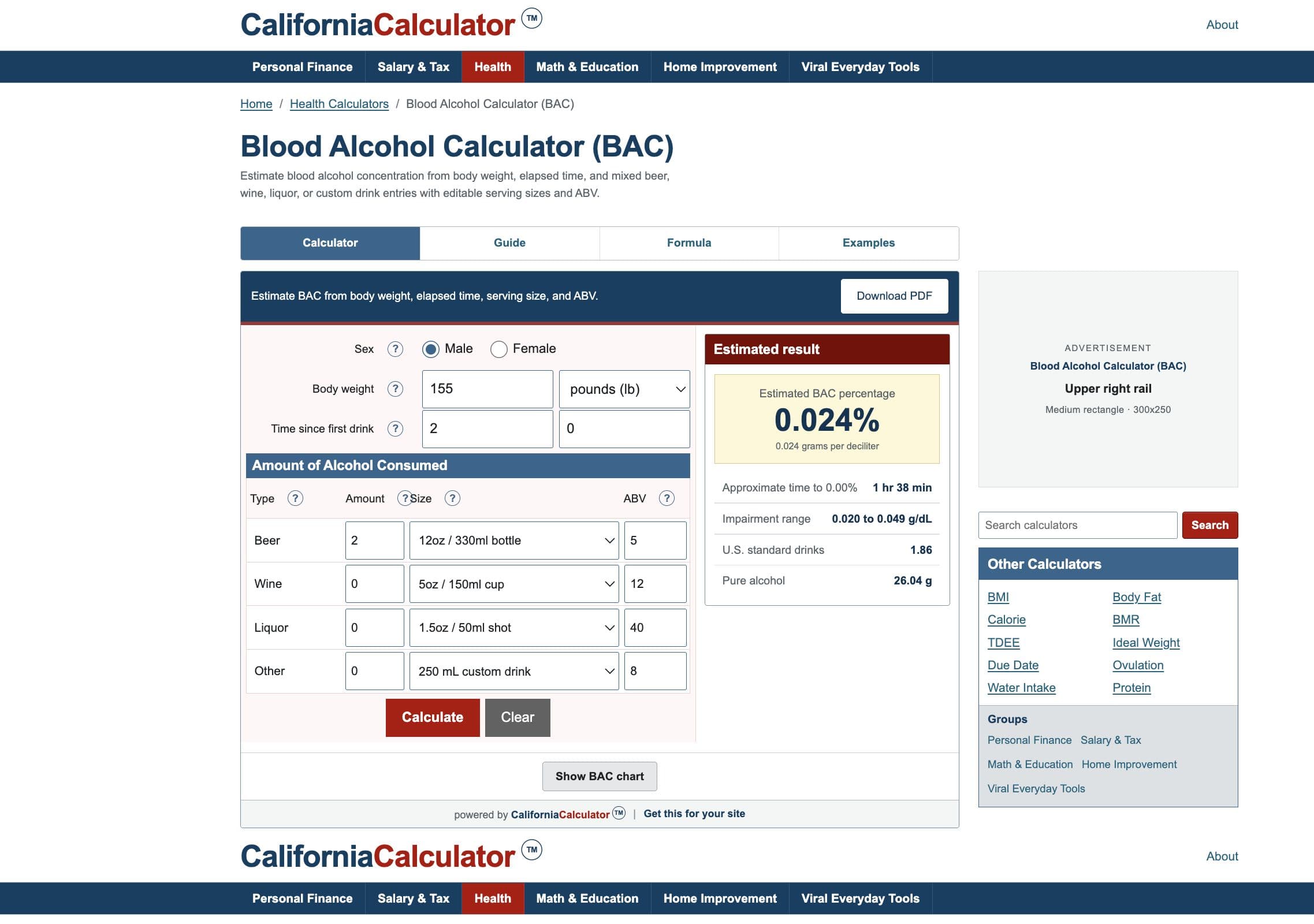
The compact calculator keeps personal details and fixed drink rows in one form. Results and the BAC time chart follow the entered values.
2. Enter Each Drink
Use Beer, Wine, Liquor, and Other in any combination. Enter zero for types not consumed. For every used row, confirm three items:
- Number of drinks: how many identical servings were consumed.
- Serving size: the volume of one serving, not the combined total.
- ABV: the alcohol by volume printed on the label or calculated from a reliable recipe.
3. Enter a Custom Pour
Choose Custom volume when a preset does not match. Enter the volume and a supported unit. For a homemade cocktail, use the total finished serving volume and a recipe-based ABV. If ABV is unknown, the estimate cannot be reliable.
4. Read the Results in Order
- Estimated BAC: the forward model after the elapsed-time deduction.
- Estimated time to approximately 0.00%: a mathematical projection, not a safe-driving time.
- Impairment range: general effects associated with the calculated range.
- Pure alcohol and standard drinks: a useful check on the entered serving sizes and ABV.
- Key assumptions: distribution ratio, elimination rate, absorption percentage, and ethanol density.
5. Use the BAC Change-Over-Time Chart
The chart shows the model from estimated peak through the current estimate and forward to mathematical zero. Hover or focus data points for values. An accessible table provides the same time and BAC values without relying on the graphic.
Worked Example: Three Regular Beers
For a 180 lb male equation term, three 355 mL beers at 5% ABV, and two elapsed hours, the tested engine produces:
| Pure alcohol | 42.01 g |
|---|---|
| U.S. standard drinks | 3.00 |
| Peak before elapsed-time deduction | 0.076 g/dL |
| Estimated current BAC | 0.046 g/dL |
| Mathematical time to zero | 3.04 hours |
See two more reproducible scenarios on the BAC examples page.
6. Interpret the Estimate Safely
Actual BAC can be higher or lower because food, drinking pace, absorption, body composition, health, medicines, and metabolism vary. A low estimate or a displayed zero does not prove sobriety, safe driving, or legal compliance.
Call emergency services if someone cannot be awakened, vomits repeatedly, has a seizure, breathes slowly or irregularly, or has clammy, pale, or bluish skin. Stay with the person and do not assume they can sleep it off.
Common Mistakes to Avoid
- Entering total volume in a field intended for one serving.
- Assuming every beer, wine pour, or shot is one standard drink.
- Using proof as ABV without converting it.
- Starting elapsed time at the last drink instead of the first.
- Treating the projected zero time as permission to drive.
- Using the calculator for a child, pregnancy guidance, legal evidence, or medical treatment.
Corrections and Review
Report an issue or error in the calculator using the Contact Us page.